Bart Geerts |
Professor, Department of Atmospheric Science Ph.D.,
Atmospheric Sciences, My work addresses the mesoscale dynamics of precipitating systems, boundary-layer circulations over flat and complex terrain, cloud dynamics, and cloud and precipitation radars. The main tools have been the Wyoming Cloud Radar (WCR) and the UW King Air aircraft. |
|
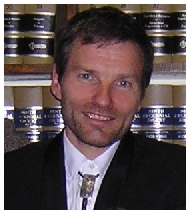
Dynamics and
microphysics of orographic precipitation (since 2006). We have been taking the UW King Air with radar
and lidar over
Dynamics of radar fine-lines in the pre-convective continental boundary layer (since 2002). We used data collected in IHOP (International Water Vapor Experiment, May-June 2002, funded by NSF), in particular the UW King Air and WCR data, to examine a vertical velocity bias found in radar data of the optically-clear convective boundary-layer, the dynamics of coherent eddies in the convective boundary-layer, the fine-scale structure of boundaries such as cold fronts and drylines, and convective initiation mechanisms. In a future campaign, we hope to further study dryline formation (incl. land surface processes) and dryline fine-scale dynamics.
Boundary-layer circulations over relatively warm water (since 2004).
Lake-effect cloud streets were examined during cold-air outbreaks over Lake Michigan, using the UW King Air and WCR in a NASA-funded project in early 2004. We characterized the vertical velocity and buoyancy characteristics of the
convective cells that make up cloud streets. BL circulations over
warm water and downstream land areas further as part of
OWLES (Eastern Great
Lakes Lake Effect Snow Project), an NSF-funded project scheduled for Dec 2013 -
Jan 2014.
-
ATSC 2000 : Introduction to Meteorology
-
ATSC 3032: Weather Analysis and Forecasting
-
ATSC 5160 and 5007 : Synoptic Meteorology - Spring semester
-
ATSC 5008 : Mesoscale Dynamics - Fall semester
|
Page comments to: geerts@uwyo.edu Last updated: 05/20/2013 |
|
